
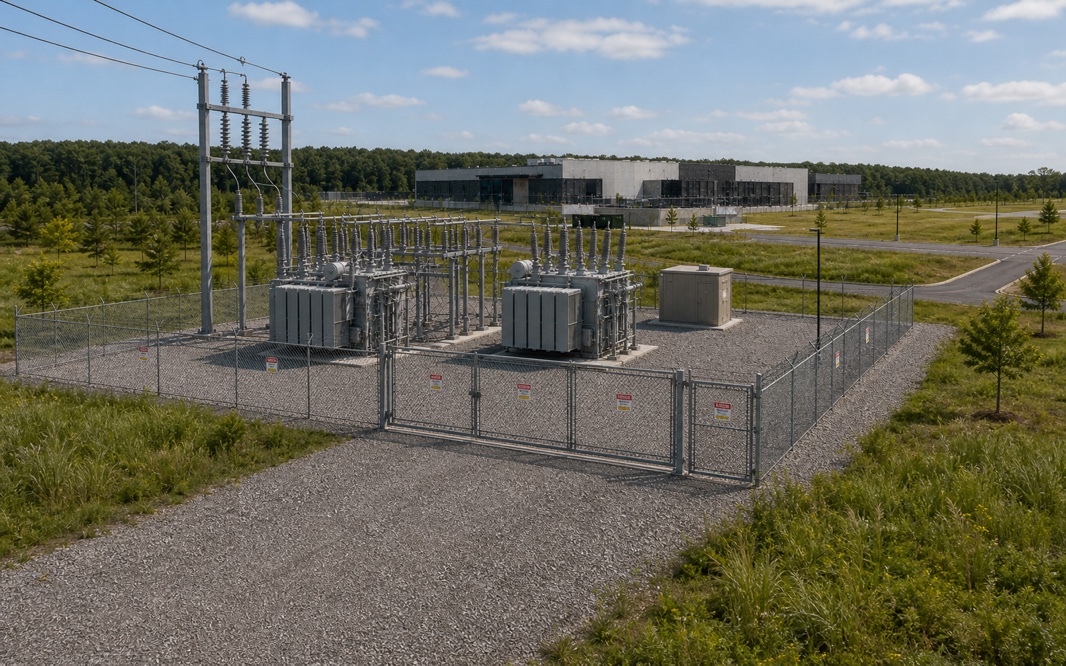
Artificial intelligence lives in the cloud, but the cloud still needs a place to land. That may sound like wordplay, and it’s also the first thing I think about whenever people start talking about the race to build AI infrastructure. My background is in real estate and deal-making, so I tend to look straight past the processor and start with the property instead: can this site actually get the power it needs, and can the land carry what has to be built on it? The technology may be extraordinary, but the physical rules governing it are still very ordinary ones.
That is how we approach data center opportunities at Anfield Ltd.
Power Comes First
Everyone talks about chips and servers, and before either can go to work, electricity has to reach the building in the amount required and on a timeline that makes the whole project viable. The scale here is easy to underestimate. Lawrence Berkeley National Laboratory, in the update it published for the Department of Energy this June, put American data center consumption at 192 terawatt-hours in 2024, which is about 4.7 percent of all the electricity used in this country, and a terawatt-hour is one billion kilowatt-hours. Its reference case has that reaching 649 terawatt-hours by 2030, or 11.8 percent of national use, with the full range of its scenarios running from 9.5 to 15.3 percent.
There’s a detail in that update worth sitting with. The lab revised its own historical numbers slightly downward from the previous year’s report, because reported shipments of GPUs for 2023 and 2024 came in below what the earlier estimate had assumed. Even the people counting this most carefully had been running a little ahead of what actually got installed.
Those are national numbers, but power gets delivered locally, and that distinction matters more than it sounds. A region can have plenty of generation on paper while one particular site still lacks the substation capacity or the transmission path it needs, because the electricity has to move through a real network and that network has real physical limits. Power on paper is not power at the plug.
Available power also comes with a timetable. Interconnection is the study and agreement process used to connect a large new customer to the grid, and it’s the process that tells the utility what equipment will be needed, what it may cost, and how long the work could take. A viable site also needs resilient fiber connectivity, but power is often the first constraint that determines whether the project can move forward.
In June 2026 the Federal Energy Regulatory Commission directed all six regional grid operators under its jurisdiction to justify or reform the rules governing how data centers and other large power users connect, and it used a phrase that captures the whole issue perfectly: speed to power.
The demand is real, but not every request becomes a project. PJM’s 2026 forecast still shows major long-term growth in electricity demand, and at the same time PJM reduced parts of its near-term forecast after utilities did a better job of testing which large-load requests had firm commitments behind them. That isn’t a contradiction at all. It’s the difference between demand on a presentation and demand that’s ready to be energized, because an announcement is not an electrical connection.
Land Makes It Real
Land is where the technology story quietly becomes a real-estate story. A parcel can look perfect on a map and still fail completely in practice: the zoning may not allow the use, the roads may not support construction traffic, the route for new power may cross property the developer doesn’t control, and the surrounding community may have entirely fair questions about what the project will mean for them.
Real estate has taught me that land is never just land, because its value comes from what can actually be built on it and how long that’s going to take.
In his June concurrence, FERC Commissioner David Rosner pointed to physical site control as one way to separate serious large-load proposals from the speculative ones. In plain English, the party asking for power should have a real path to the property sitting behind the request, and while that sounds obvious enough, obvious things have a way of getting skipped in a fast-moving market.
Constraints Create Value
Constraints create value, which is the part most people miss. The best site may not be the biggest parcel or the cheapest land at all, and it’s often the property with a credible path to power and a workable path through zoning, one that also fits the community where it’s going to operate.
That’s exactly why utilities and local governments need to be in the conversation with property owners early rather than late. Technology companies bring the demand, and the site team is what turns that demand into something that can actually be built.
There’s also more room for flexibility here than the debate usually allows. FERC is examining new service structures for large users that can adjust how much power they draw from the grid, and new generation located near a major user may also reduce the amount of additional transmission work required. The right answer will vary by region, but the larger point holds regardless: power planning and site planning can no longer happen in separate rooms.
AI may be changing faster than almost any technology we’ve seen, but infrastructure still moves at physical speed, and that means land has to be controlled, power has to be delivered, and the people who live nearby have to be heard. The cloud is not weightless. It rests on land, it runs on power, and it has to live in a real community, which is why power and land decide where AI infrastructure gets built.